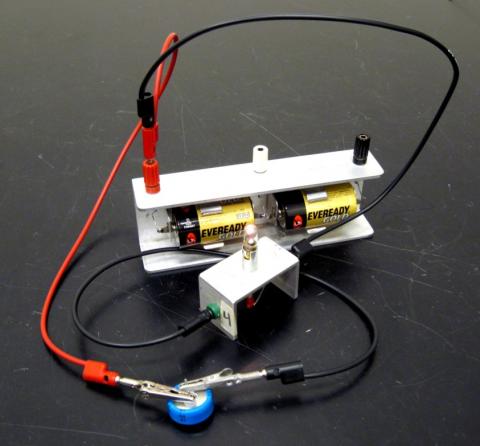

Charging/Discharging a Capacitor through a Light Bulb
This demonstrates energy storage in a capacitor as well as charging and discharging rates
If a resistor (the light bulb) is connected in series with the capacitor forming an RC circuit, the capacitor will charge up gradually through the resistor until the voltage across it reaches that of the supply voltage. The time required for the capacitor to be fully charge is equivalent to about 5 time constants or 5T. Thus, the transient response or a series RC circuit is equivalent to 5 time constants.
T=RxC
R is the resistor value measured in ohms
C is the capacitance of the capacitor measured in farads
T is the transient response time measured in seconds
For Charging
Since voltage V is related to charge on a capacitor given by the equation, Vc = Q/C, the voltage across the capacitor ( Vc ) at any instant in time during the charging period is given as
Vc = Vs(1-e-t/(RC))
Where
Vc is the voltage across the capacitor
Vs is the supply voltage
t is the elapsed time since the application of the supply voltage
For Discharging
For a RC discharging circuit, the voltage across the capacitor ( Vc ) as a function of time during the discharge period is defined as
Vc = V0e-t/(RC)
Where
Vc is the voltage across the capacitor
V0 is the voltage of the capacitor the moment before the power supply was removed
t is the elapsed time since the removal of the supply voltage